Common Sense—Gets Rewarded
AI is not making common sense obsolete. It is making good judgement easier to recognise—and more valuable than ever. Artificial intelligence can produce an answer in seconds, but it cannot guarantee that the answer suits your situation, reflects your values or passes the “does this actually make sense?” test.
That is where decades of experience become an advantage. If you have managed a household, worked with customers, supervised staff, solved practical problems or simply learned when something sounds too good to be true, you already possess skills that AI needs from its human operator.
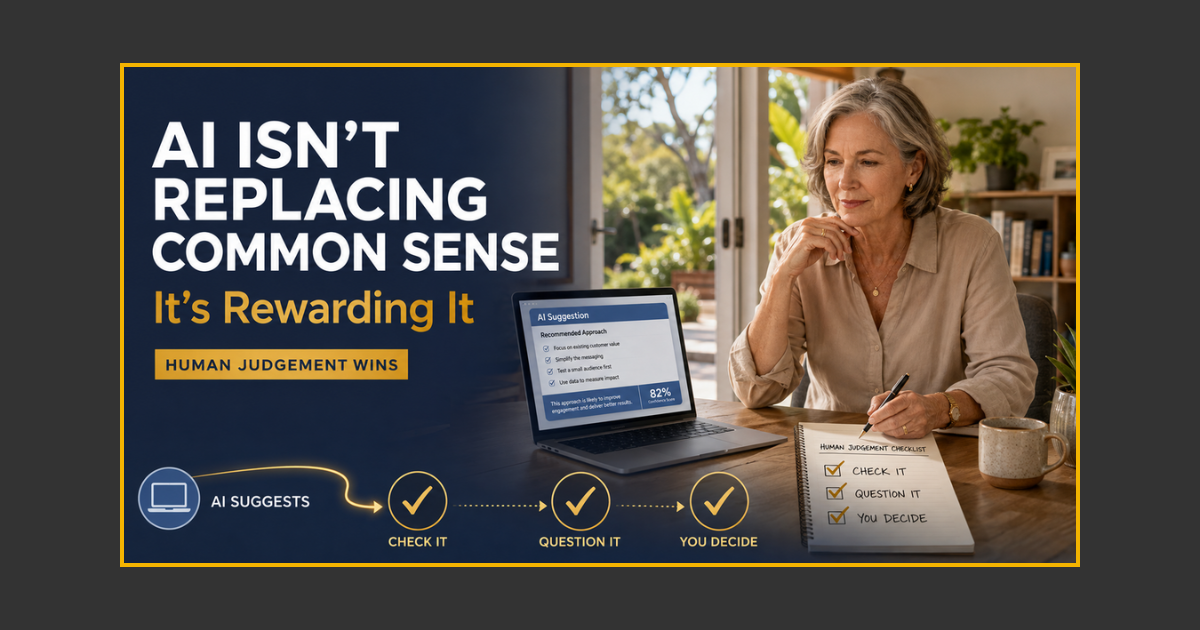
The winning combination is not AI instead of human thinking. It is AI for speed, followed by human judgement for direction, checking and the final decision.
AI Can Sound Certain Without Being Correct
AI is excellent at producing fluent language. That fluency can create a dangerous illusion: if an answer sounds polished, it must be right. Yet AI may misunderstand your question, use outdated information, combine unrelated facts or invent a detail that appears perfectly plausible.
Imagine an enthusiastic new employee who has read every filing cabinet but has never met your customers. They can draft quickly, suggest options and organise information. You would still check an important letter before it left the building. AI deserves the same supervision.
The beginner mistakes explained in Five AI Mistakes Beginners Make are rarely technical failures. They usually involve vague instructions, missing context or accepting the first answer without checking.
What Common Sense Contributes
It notices when the answer does not fit the situation
An AI might suggest a complex ten-step system for a job that needs a phone call. Common sense asks whether the proposed solution is proportionate to the problem.
It recognises hidden costs
A tool may promise to save time while requiring hours of setup, a monthly subscription and three more tools to make it work. Experience teaches you to count the full cost, including learning, checking and maintenance.
It reads people
AI can recommend wording, but you understand whether a worried customer needs reassurance, whether a joke is appropriate and whether a message will sound cold. Human context turns acceptable copy into useful communication.
It questions convenient answers
We naturally like answers that confirm what we already hoped. Common sense slows down when the result involves money, health, legal obligations or an unfamiliar offer.
It knows when to ask an expert
Good judgement does not mean knowing everything. It means recognising the point where professional advice, an official source or another experienced person is needed.
Aha! moment: The faster AI produces answers, the more valuable the person becomes who can tell a useful answer from an attractive mistake.
The Five-Question Common-Sense Check
Before using an AI response, ask:
- Does it make sense? Read it as if someone else had written it. Look for contradictions, missing steps and impractical suggestions.
- What needs verification? Mark names, dates, prices, statistics, quotations, laws and links.
- What context might be missing? Consider country, audience, budget, timing and personal circumstances.
- What could go wrong? Think about privacy, cost, reputation and the effect on other people.
- Who makes the final decision? The correct answer is you—or a qualified professional—not the software.
This review does not cancel the time AI saves. It is part of the job. Can AI Really Save You Time? I Timed It So You Don’t Have To explains why honest time comparisons include checking and editing.
Common Sense in Everyday AI Tasks
Writing an email
AI drafts a polite response. You check the names, promise dates and tone. If the customer is already frustrated, you remove chirpy language and acknowledge the real problem.
Planning a holiday
AI suggests an itinerary. You check opening hours and travel times on official sites, consider mobility and rest, and decide whether five attractions in one afternoon sounds like a holiday or a military exercise.
Researching a purchase
AI compares features. You confirm current prices, warranty conditions and independent reviews. You ask whether the extra feature solves a genuine need.
Creating business content
AI writes a first draft. You remove invented claims, add your experience and make sure the offer is honest. The human-led approach in How to Build a Simple AI Business Without Feeling Like a Salesperson keeps usefulness ahead of hype.
How to Give AI Better Judgement to Work With
AI cannot read the room unless you describe the room. Include the information a sensible assistant would need:
- The goal and why it matters
- The reader or person affected
- Your budget, time and practical limits
- What has already been tried
- Risks or facts that must be checked
- The tone and format you want
Then ask the AI to challenge the plan rather than simply agree with it: “List three weaknesses in this approach, identify the assumptions and tell me what information should be verified.”
Clearer instructions improve the draft, as shown in The Beginner’s Guide to Writing Better AI Prompts. They do not remove your responsibility to review it.
A Practical Common-Sense Prompt
I am considering [decision]. My goal is [goal], and my important limits are [budget, time, location or other limits]. Help me compare the options in plain English. State your assumptions, identify facts that may have changed, list what I should verify using official sources and give three reasons your recommendation might not suit me. Do not make the final decision for me.
Red Flags That Deserve a Pause
- A claim of guaranteed income or success
- Pressure to act immediately
- A recommendation involving private information
- Sources that cannot be opened or confirmed
- An answer that ignores your country or circumstances
- A long solution to a very small problem
- A response that agrees with every assumption you make
If something feels wrong, stop. Ask the AI what evidence supports its answer, check an authoritative source or speak to someone qualified. The pause is not a failure to use technology. It is evidence that you are using it responsibly.
Why Experience Is an AI Advantage
Younger users may move faster through an unfamiliar screen. Speed with buttons is useful, but it is not the whole skill. Experience brings pattern recognition, patience, context and a memory of what happened last time a “guaranteed opportunity” arrived wearing a shiny new hat.
AI rewards people who can explain the goal, recognise weak output and improve it. Those abilities come from doing real work and living a real life. Your knowledge is not baggage to drag into the AI era. It is the steering wheel.
A Five-Minute Judgement Exercise
Choose a low-risk question you already understand well—perhaps how to prepare a familiar meal, organise a club meeting or complete a task from your former work. Ask AI for a step-by-step answer, then review it with a pencil or notepad.
- Circle one part that is accurate and genuinely useful.
- Underline one instruction that needs more context.
- Cross out anything impractical, unnecessary or incorrect.
- Add one detail from your own experience that improves the result.
- Ask AI to rewrite the answer using your corrections.
This exercise reveals the correct relationship very quickly. AI creates a fast starting point; you supply standards, context and lived knowledge. Practising on a familiar subject also makes errors easier to spot, which builds the checking habit before you tackle unfamiliar or important decisions.
Final Thoughts
Artificial intelligence can draft, compare, organise and suggest at remarkable speed. Common sense decides whether the result is accurate, suitable, safe and worth acting upon.
Use AI confidently, but never hand over the keys. Ask clearly, question attractive answers, verify important details and make the final choice yourself. In a world full of instant responses, thoughtful judgement is not becoming old-fashioned. It is becoming a superpower.
Keywords: AI and common sense, human judgement in AI, responsible AI use, AI for beginners, human-led AI, artificial intelligence over 50
.png?width=1024&height=1024&name=Over%20Fifties%20AI%20Academy%20Logo%20(trans).png)