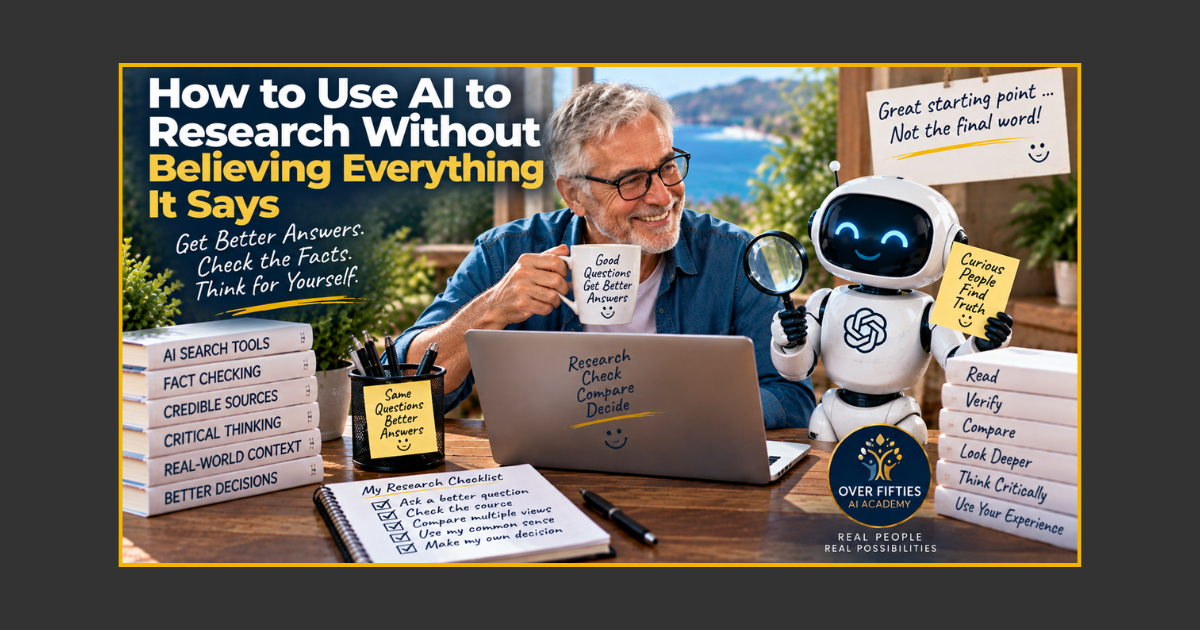
AI Can Help You Research—But It Should Never Be Your Only Source
AI can make research feel ridiculously easy. Ask a question and within seconds you can receive a neat explanation, a comparison, a list of ideas and perhaps even a few impressive-looking facts.
There is only one problem: impressive-looking is not the same as correct.
Artificial intelligence can be extremely useful for exploring a subject, understanding unfamiliar terminology and deciding what to investigate next. But if the information matters, you still need to check it.
This is not a reason to avoid AI. It is a reason to use it properly.
First, Understand What AI Is Good at During Research
AI is excellent at helping you get your bearings.
If you know almost nothing about a subject, you can ask:
Give me a beginner-friendly overview of this topic. Explain the main terms I should understand and suggest five questions I should research next.
That can turn a confusing subject into a manageable starting point.
You can also ask AI to:
- suggest search terms;
- explain jargon in plain English;
- compare two concepts;
- organise information you have already collected;
- identify questions you may have overlooked;
- summarise material you provide.
These are valuable research jobs because AI is helping you navigate information.
The trouble begins when navigation is mistaken for proof.
AI Can Sound Certain When It Is Wrong
One of the hardest habits for new AI users to develop is questioning a beautifully written answer.
Humans naturally associate confident language with knowledge. AI can produce confident language whether the underlying information is solid, outdated, misunderstood or simply wrong.
That means you should never judge accuracy by tone.
Common-sense rule: The more important the fact, the less you should rely on how convincing the AI sounds.
This is one reason AI Isn't Replacing Common Sense—It's Rewarding It. AI gives us faster access to possibilities, but judgement is still required to decide what deserves our trust.
Ask for Sources—Then Check Them
If you are using an AI tool that can search the web or provide sources, ask it to show you where important claims came from.
For example:
Find current information about this topic. Give me the source for each important factual claim, include the publication date where available, and clearly tell me when something cannot be verified.
Then do the part that matters most: open the sources yourself.
Check whether the source really says what the AI claims it says. Look at who published it. Check the date. Decide whether it is appropriate for the question.
A link beside an answer is not a magic certificate of truth.
Check the Date
Some information ages slowly. The history of the printing press is not likely to change dramatically between breakfast and lunch.
Other information can become stale very quickly:
- prices;
- laws and regulations;
- software features;
- travel requirements;
- business opening hours;
- government programs;
- product specifications;
- news and current events.
If the answer depends on what is true now, check when the source was published or last updated.
You can even make date checking part of your prompt:
Prioritise sources published or updated within the last 12 months. If an older source is necessary, explain why it is still relevant.
Use the Best Source for the Question
Not all sources carry equal weight.
If you want to know the current rules for an Australian government service, start with the relevant government website rather than a random blog post.
If you need the specifications of a product, the manufacturer's current documentation is generally more useful than an old forum discussion.
If you are researching health, legal or financial matters, the stakes are higher again. AI can help you understand questions to ask, but important decisions should be checked against reliable authoritative information and, when appropriate, a qualified professional.
Think of AI as the research assistant helping you find the filing cabinet—not the person who automatically decides which document is correct.
Verify Important Claims With More Than One Reliable Source
For low-stakes questions, one good source may be enough.
For something important, compare reliable sources.
Suppose AI tells you a particular rule changed this year. Search for the official announcement. Then look for another reputable source explaining the change.
If the sources disagree, do not ask AI to simply pick the answer you prefer. Investigate why they disagree. One source may be older. One may refer to a different country. One may be discussing a proposed change rather than a law already in force.
This is where human judgement becomes part of research.
Separate Brainstorming From Factual Research
This is one of the easiest ways to use AI more safely.
Brainstorming: “Give me ten ideas for an ebook about caravan travel.”
There is no single correct answer. You are looking for possibilities.
Factual research: “What are the current towing regulations in Queensland?”
Now accuracy, location and current information matter.
The first task is ideal for creative AI assistance. The second should lead you toward current authoritative sources.
Knowing which kind of task you are doing changes how much checking is required.
Watch for the Little Details That Change the Answer
Research questions often depend on context.
A rule may be different in Australia and the United States. A price may be in Australian dollars or US dollars. Software instructions may apply to an older version. A government benefit may depend on age, income or residency.
Give AI the relevant context before asking the question.
AI Doesn't Know You—Until You Teach It explains why background information can transform an answer from generic to genuinely useful.
But remember: better context improves relevance. It does not guarantee factual accuracy.
Do Not Let AI Invent Missing Information
If you are asking AI to work with material you provide—meeting notes, research documents, interview transcripts or your own records—tell it what to do when information is missing.
Try:
Use only the information I provide. If the answer is not supported by my material, say “I don't have enough information” rather than guessing.
This is especially useful when summarising or extracting facts from your own documents.
It also reinforces a useful habit: sometimes the correct answer really is “we don't know yet.”
Be Wary of Urgency, Fear and Miraculous Claims
The internet has always contained misinformation. AI did not invent it.
What AI changes is the speed at which information can be summarised, rewritten and presented professionally.
If something makes you feel you must act immediately—especially involving money, passwords, personal information or a supposedly urgent account problem—slow down and verify it independently.
Our guide to How to Spot AI Scams Before They Spot You covers the warning signs worth watching for when technology and persuasion are combined.
A Five-Step AI Research Routine
You do not need a complicated system. Try this:
- Explore: Ask AI for a plain-English overview and useful questions.
- Source: Ask for current, relevant sources for factual claims.
- Open: Read the important sources yourself.
- Cross-check: Verify significant claims elsewhere when the stakes justify it.
- Decide: Use your own judgement before acting on the information.
That is a much healthier research workflow than copying the first AI answer into a document and declaring the case closed.
If you are still building confidence with everyday AI use, Five AI Mistakes Beginners Make (And How to Avoid Every One) covers several other habits that can improve your results.
Research Faster Without Switching Off Your Brain
AI can be one of the best research assistants most of us have ever had.
It can explain unfamiliar subjects, suggest better questions, organise mountains of information and help us reach useful sources much faster.
But the final responsibility remains with us.
Ask where information came from. Check the date. Prefer authoritative sources when accuracy matters. Verify important claims. Be willing to say, “I'm not convinced yet.”
AI can help you research faster.
Your common sense decides what deserves to be believed.
Keywords: AI research, how to use AI for research, AI fact checking, AI for beginners, ChatGPT research, artificial intelligence over 50, verify AI information, digital confidence