Your Experience May Already Contain Your First Digital Product
Digital product ideas do not always begin with a brilliant new invention. Quite often, they begin with something you have been doing, explaining or solving for years. If you are over 50, your career, hobbies, family life and practical experience may already contain knowledge that somebody else would happily use to save time, avoid mistakes or learn a useful skill.
The difficulty is that we tend to undervalue what comes easily to us. After doing something for 20 or 30 years, it can feel ordinary. To a beginner, however, the shortcut you barely think about may be exactly the information they need.
AI can help organise that knowledge into an ebook, checklist, template, planner or short guide. But the valuable ingredient comes first: your experience. The trick is learning how to recognise it.
Why Your Most Useful Knowledge Can Feel Ordinary
Think about the jobs you can now do almost automatically. Perhaps you can organise a family event without forgetting anything, grow tomatoes in difficult soil, prepare a caravan for a long trip, train a new employee, restore furniture, manage club finances or explain a complicated workplace process in plain English.
You probably remember when those things were not automatic. You learned through instruction, mistakes, repetition and the occasional colourful word when something went wrong.
That learning has value because a beginner is standing where you once stood.
Aha! moment: If you can save a beginner three hours, three mistakes or three weeks of confusion, you may have the beginnings of a useful digital product.
This is the same principle explored in How to Turn What You Already Know Into Your First Digital Product: useful products start with a real problem, not with fancy technology.
Start With One Simple Question
Instead of asking, “What digital product could I invent?” ask something much easier:
What do people already ask me for help with?
Take a sheet of paper and write down anything that comes to mind. Do not judge the ideas yet. Include questions from friends, family, former workmates, customers, neighbours or members of clubs and community groups.
Your list might include:
- Career knowledge: “How do you quote that job?” or “What should I check before I send this to a client?”
- Practical skills: “How do you get that finish?” or “What tools do I actually need?”
- Hobbies: “How do you plan your vegetable garden?” or “What should a beginner buy first?”
- Organisation: “How do you keep track of all those bookings?”
- Family experience: “What did you pack for that long road trip?”
- Technology: “How did you make that ebook?” or “How do you use AI to write that?”
Do not dismiss an idea because it seems simple. Simple is often an advantage. A beginner usually wants the shortest safe path to a result, not a university course on the subject.
Turn the Question Into a Result
Now look at each question and ask: What result does this person actually want?
Someone asking how you prepare a caravan may really want to leave home without worrying that they have forgotten something important. Someone asking how you make an ebook may want a simple way to turn their own knowledge into a finished product.
The result helps determine the product.
- A repeated list of things to remember could become a checklist.
- A process with several stages could become a step-by-step guide.
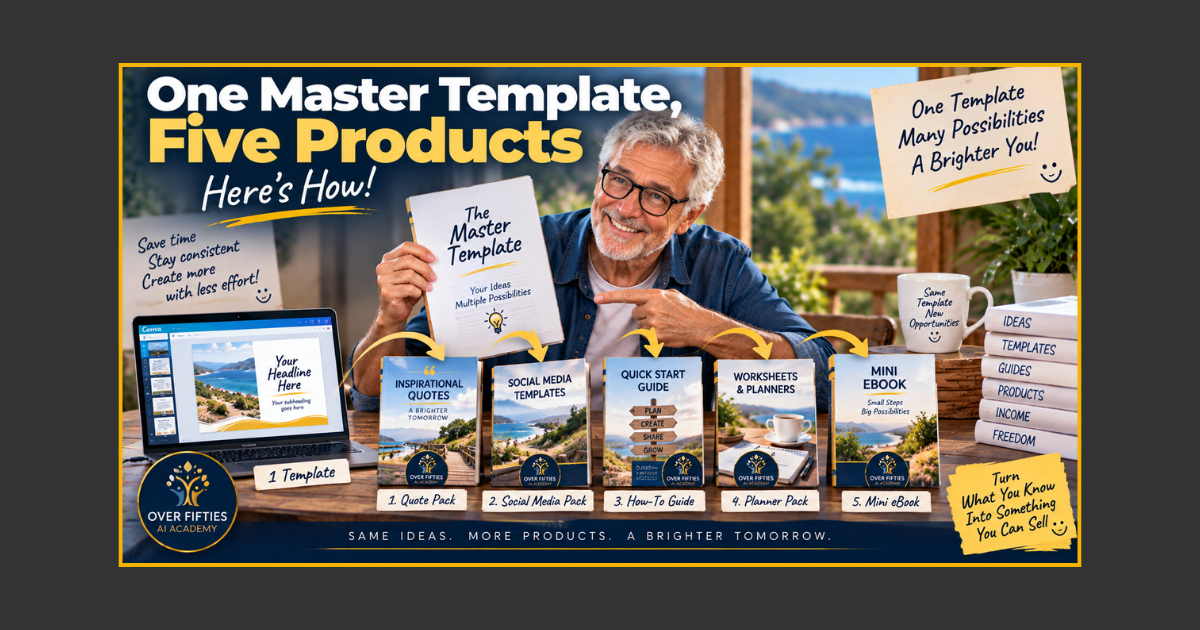
- A document you repeatedly recreate could become a template.
- A collection of useful questions or instructions could become a prompt pack.
- A subject that needs explanation and examples could become a short ebook.
- A repeated weekly or monthly process could become a planner or worksheet.
If you are unsure which format suits your idea, What Should Your First Digital Product Actually Look Like? compares several beginner-friendly options.
Try the “Ten-Minute Experience Audit”
Set a timer for ten minutes and make four headings on a page:
- Things I know from work
- Things I know from hobbies
- Problems I have solved in everyday life
- Things people ask me to explain
Write quickly. Your goal is not to find the winning idea immediately. Your goal is to stop treating decades of accumulated knowledge as though it arrived free with the furniture.
When the timer finishes, circle three ideas that meet these tests:
- You understand the subject from real experience.
- A recognisable group of people has the problem.
- You can explain a useful result in one sentence.
- The first version could be small enough to finish.
That final point matters. Your first digital product does not need to contain everything you know. In fact, a smaller product that solves one problem is often easier for both the creator and the customer. The article Your First Ebook Doesn't Need to Be 100 Pages uses the same one-reader, one-problem, one-outcome approach.
Where AI Fits Into the Process
Once you have chosen a real piece of knowledge, AI becomes useful. It can help you organise what is already in your head.
For example, you could give your AI assistant a rough description of your idea and say:
I have experience with [subject]. Beginners often ask me [question]. I want to create a simple digital product that helps [type of person] achieve [result]. Ask me ten questions, one at a time, to uncover the practical steps, mistakes, examples and tips I have learned from experience. Do not invent my experience for me.
That last sentence is important. AI should interview you, organise your ideas and help with the first draft. It should not manufacture stories or expertise you do not have.
This human-led approach is what makes your product yours. AI provides speed. You provide judgement, examples, personality and the knowledge of what actually works.
Do Not Wait for a Completely Original Idea
People have been writing cookbooks for centuries, yet new cookbooks still appear. The value is not that nobody has ever cooked dinner before. The value comes from the audience, selection, explanation, experience and approach.
Your product can cover a familiar problem and still be useful because you explain it differently. You may understand the concerns of a particular trade, age group, hobby or situation better than a generic guide ever could.
The goal is not to copy somebody else's work. It is to take knowledge you genuinely possess and organise it into a useful shortcut for somebody a few steps behind you.
From an Idea to Something You Can Actually Finish
Once you have identified the idea, the next jobs are straightforward: decide who it is for, choose the problem, select the format, organise the content, create the product and prepare a simple way to sell it.
If you would like those steps laid out in one beginner-friendly system, the Over Fifties Digital Product Starter Kit™ was created to help you move from “I know something useful” to a finished digital product without needing a website, coding skills or a technical background.
You do not need to start there today. Start with the ten-minute experience audit. Circle one idea. Then ask yourself whether solving that one small problem would make somebody else's life easier.
If the answer is yes, you may be closer to your first digital product than you thought.
Keywords: digital product ideas, how to create a digital product, digital products for beginners, sell digital products, online business over 50, passive income ideas, side hustle ideas, turn knowledge into income