Do't Believe Everything You Hear
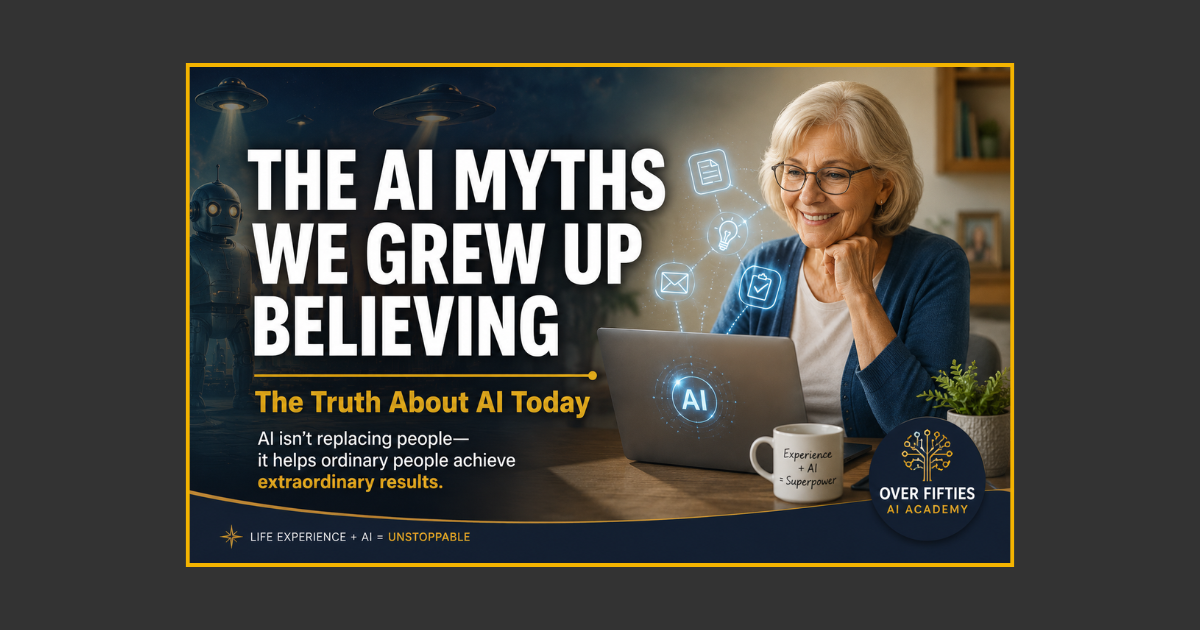
For many of us over 50, our first introduction to artificial intelligence did not come from a computer screen. It came from science-fiction films, television shows and novels where intelligent machines usually had one thing on their mind: taking over.
We grew up with computers that filled rooms, robots that spoke in metallic voices and stories where machines became smarter than the people who built them. So it is hardly surprising that the words artificial intelligence can still sound a little ominous.
But the AI most of us use today is far less dramatic. It is helping people draft emails, organise notes, plan holidays, create images, explain complicated subjects and turn rough ideas into useful first drafts. No red flashing eyes required.
The biggest change is not that machines have suddenly become human. It is that ordinary people now have access to tools that can help them think, write, research and organise faster.
Myth 1: AI Thinks Like a Human
One of the biggest myths is that modern AI sits inside your computer thinking, reasoning and forming opinions in the same way you do.
It does not.
AI systems are very good at recognising patterns and producing responses based on enormous amounts of information. They can sound remarkably human because language itself follows patterns. But sounding thoughtful and actually possessing a lifetime of judgement are two very different things.
Think of AI as an extremely well-read assistant who can produce a draft quickly but has never lived your life, raised your family, worked your job or dealt with your customers.
That is why your experience matters. As we explained in AI Isn’t Replacing Common Sense—It’s Rewarding It, AI can provide speed, but humans still provide context, judgement and the final decision.
Myth 2: AI Is About Replacing People
Science fiction loves a good replacement story. The machine becomes stronger, faster and smarter, and the poor human ends up wondering where the parking spot went.
In everyday life, the more useful question is not, “Will AI replace me?” It is, “Which parts of this job can AI help me do more easily?”
A bookkeeper might use AI to draft a client explanation. A retiree might use it to plan a travel itinerary. A small business owner might turn rough notes into a social media post. Someone creating an ebook might use AI to organise a chapter outline.
In each case, the person still decides what needs doing, checks the result and makes the final call.
AI works best when it removes some of the heavy lifting without removing the human being from the job.
This is the idea behind human-led AI: the machine assists, but you stay in charge.
Myth 3: You Need to Be Technical to Use AI
This belief keeps far too many capable people on the sidelines.
You do not need to understand computer programming to use a conversational AI tool any more than you need to understand an automatic transmission before driving a modern car.
You need to know what you want, explain it clearly and check the result.
That is why learning to use AI often feels easier once you stop trying to sound technical. A useful prompt can be as simple as:
I am planning a three-day trip to Melbourne. I enjoy history, good coffee and easy walking. Create a relaxed itinerary with no more than three activities per day. Ask me three questions before you begin.
That is not computer code. It is a clear briefing.
If you want to practise this skill, The Beginner’s Guide to Writing Better AI Prompts explains how to give AI clearer instructions without technical jargon.
Myth 4: AI Always Knows the Answer
Modern AI can produce an answer with impressive confidence. Unfortunately, confidence and accuracy are not the same thing.
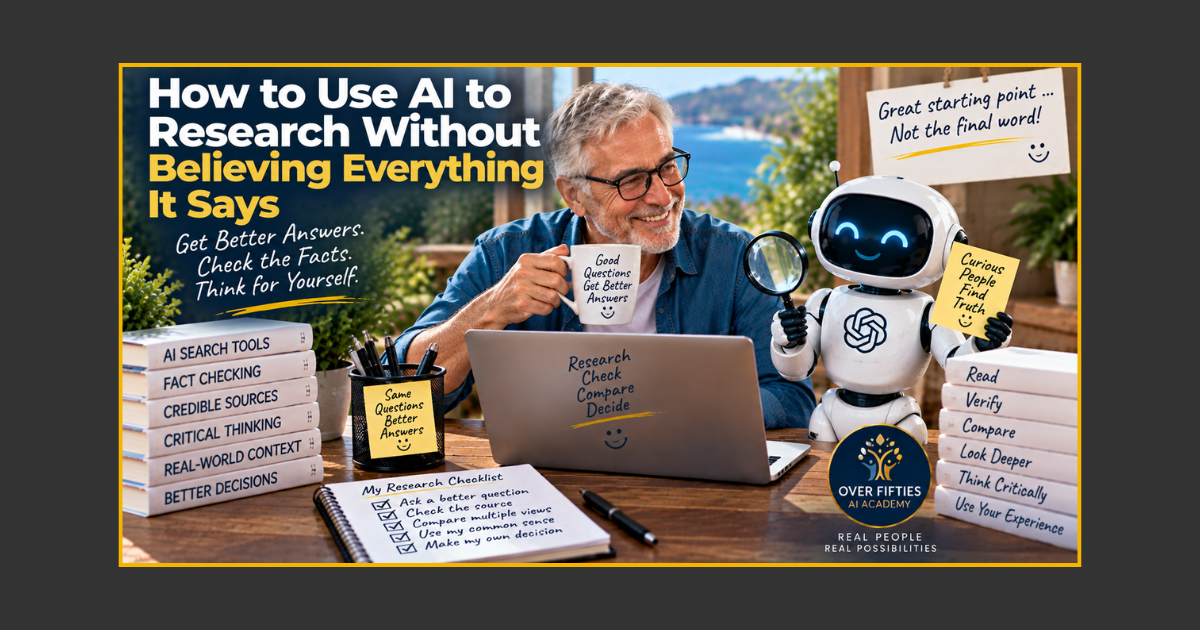
AI can misunderstand a question, use outdated information or invent a detail that sounds perfectly believable. That means important facts should still be checked against reliable sources.
This is especially important for:
- Medical information
- Legal or financial decisions
- Current prices and product features
- News and rapidly changing information
- Names, dates, quotations and statistics
A useful rule is simple: the more important the decision, the more important the checking.
Beginners often discover this after accepting a polished answer too quickly. Five AI Mistakes Beginners Make shows how to build a sensible checking habit from day one.
Myth 5: AI Will Make Everybody an Expert Overnight
AI makes some tasks faster. It does not magically give us decades of knowledge.
If you know your subject well, AI can become extremely useful because you can recognise a strong answer, spot a weak one and provide better instructions. If you know very little about the subject, you may not notice when the AI has wandered off course.
This is why people over 50 may have a bigger advantage than they realise.
You have spent decades learning how people behave, how workplaces operate, how money gets wasted, how projects go wrong and what a sensible solution looks like. AI can add speed to that experience.
Life experience combined with AI is a genuine superpower—not because the machine knows everything, but because you know enough to supervise it.
Myth 6: You Have to Learn Everything at Once
The AI industry does a magnificent job of making yesterday’s new tool look ancient by lunchtime.
Ignore most of that noise.
You do not need fifty tools, six subscriptions and a dashboard that looks like the cockpit of a 747. Start with one general AI assistant and one useful job.
For example:
- Rewrite one awkward email.
- Turn a page of notes into a checklist.
- Ask for three dinner ideas from ingredients already in the fridge.
- Summarise a non-confidential document.
- Create five questions to research before buying something expensive.
Small tasks build confidence because you already know what a sensible answer should look like. That same approach is explored in Why Small AI Habits Beat Big AI Courses Every Time.
What AI Really Looks Like in 2026
For most people, useful AI is not a robot walking through the front door. It is a quiet layer of assistance inside tools we already use.
It can help you:
- Get past the blank page
- Organise scattered ideas
- Compare options
- Create a first draft
- Explain unfamiliar topics in plain English
- Repurpose one idea into several formats
- Build repeatable workflows for regular jobs
Those are practical improvements, not science-fiction revolutions.
Quick tip: The easiest way to make AI less intimidating is to give it one ordinary task you already understand. Familiar work makes it much easier to judge the result.
A Five-Minute Myth-Busting Exercise
Open your usual AI assistant and try this prompt:
I am over 50 and still learning how artificial intelligence can be useful in everyday life. Ask me five questions about tasks I regularly do at home, work or in a small business. Then suggest three simple ways AI could help me without replacing my judgement or requiring technical skills.
Read the suggestions and choose just one. Try it on a low-risk task. Check the answer and ask for one improvement.
That simple exercise will teach you more about practical AI than another evening spent watching fictional machines take over the planet.
Final Thoughts
We grew up with some spectacular ideas about artificial intelligence. They made wonderful entertainment, but they were never a particularly useful instruction manual.
Today’s AI is much more ordinary—and much more useful. It can help us write, plan, organise, learn and create. It can also make mistakes, misunderstand instructions and produce confident nonsense.
That is why the human part matters.
You do not need to become technical. You do not need to surrender your judgement. And you certainly do not need to fear every new tool that appears.
Start with one small job. Give clear instructions. Check the result. Keep what works.
The future may not look much like the science fiction we grew up with. In this case, that is probably good news.
Keywords: AI myths, artificial intelligence for beginners, AI for over 50s, AI misconceptions, human-led AI, how AI really works
.png?width=1024&height=1024&name=Over%20Fifties%20AI%20Academy%20Logo%20(trans).png)