Your First Ebook Only Needs to Solve One Useful Problem
If “write an ebook” makes you picture 100 pages, months of work and a blinking cursor judging you from a blank screen, I have some good news.
Your first ebook does not need to be enormous. It needs to be useful.
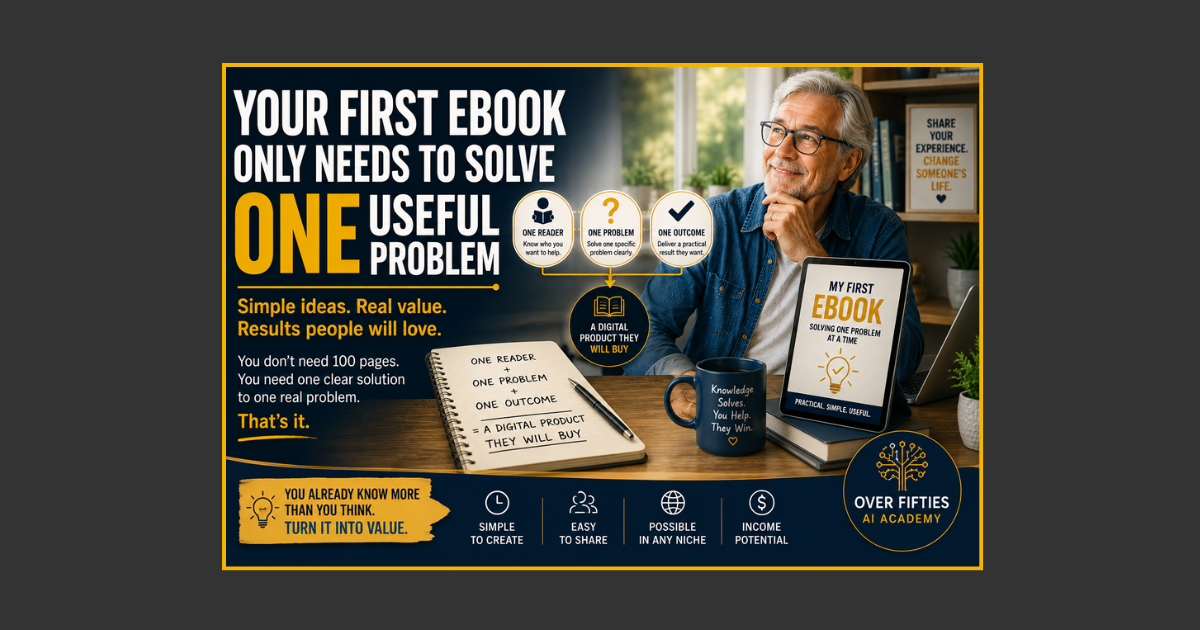
For a beginner, forget about writing “a book” and concentrate on helping one reader solve one problem and reach one clear outcome. That simple idea removes pressure and gives you a practical framework for deciding what belongs in your ebook.
Why 100 Pages Is the Wrong Ebook Goal
Page count is not the same as value. If somebody has a specific problem, they usually want a clear answer—not another doorstop for the bedside table.
A 25-page guide showing a beginner how to grow five herbs on an apartment balcony may be far more useful to that reader than a 120-page guide covering every aspect of gardening.
Aha! moment: Do not ask, “How many pages should my ebook be?” Ask, “How many pages does my reader need to solve this problem properly?”
The One Reader + One Problem + One Outcome Formula
Before writing a chapter, complete this sentence:
This ebook is for [one type of reader] who wants to [solve one problem] so they can [reach one useful outcome].
That sentence becomes your filter. Whenever you are tempted to add another topic, ask whether it helps that reader reach the outcome. If not, save it for another product.
This is the same principle behind turning what you already know into your first digital product.
Step 1: Choose an Ebook Problem You Understand
Ask yourself what people regularly ask you to explain, what confused you as a beginner, what process you have learned to simplify and what mistakes you could help somebody avoid.
You do not need to be the world's leading authority. You need enough practical knowledge to help somebody who is a few steps behind you.
Step 2: Define the Finish Line
“Learn about Canva” is vague. “Create your first reusable ebook template in Canva” has a finish line.
“Learn about AI” is enormous. “Use AI to create a weekly meal plan from food already in your kitchen” is specific.
A clear finish line helps every chapter earn its place.
Step 3: Build a Simple 5–7 Chapter Ebook
Start with a logical journey:
- The Problem: Explain what the reader is struggling with.
- What You Need: Cover basic preparation or tools.
- First Step: Help the reader begin.
- The Main Process: Explain the core method.
- Common Mistakes: Show what can go wrong.
- Put It Into Practice: Add an exercise or checklist.
- What Comes Next: Reinforce the result and next step.
Five chapters may be enough. Seven may be better. The number is not sacred; the reader's journey is.
Step 4: Outline Your Ebook Before You Write
Writing from page one without an outline is like starting a road trip by reversing out of the driveway and then deciding where you are going.
Under each chapter heading, list three to five points the reader needs to know. AI can help organise them, but start with your own knowledge first.
I am creating a beginner ebook for [reader] that will help them [outcome]. Here are the topics I believe it needs to cover: [list]. Organise these into a logical 5–7 chapter outline. Do not add new subjects unless you explain why they are necessary.
Step 5: Write One Small Section at a Time
Do not sit down thinking, “Today I have to write an ebook.” That is enough to make anybody suddenly remember the garage needs cleaning.
Write one step, one useful story, one checklist or one answer to a common question. Small sections become chapters. Chapters become an ebook.
It is the same principle behind Why Small AI Habits Beat Big AI Courses Every Time.
Step 6: Add Practical Value Instead of Extra Pages
If you want the ebook to feel more valuable, do not automatically add 20 pages. Add something the reader can use:
- A checklist
- A worksheet
- A template
- A sample AI prompt
- A quick-reference page
- An action plan
- A resource list
A reader who uses a checklist and gets a result may value your ebook more than somebody who simply reaches page 100.
Step 7: Edit for the Reader
Look for jargon, assumed knowledge, repetition, long sections that could become bullets, missing examples and facts that need checking.
Your job is not to prove how much you know. Your job is to make the reader's journey easier.
Quick tip: If removing a paragraph makes the ebook clearer without removing anything the reader needs, delete it. Clear beats long.
Where AI Fits Into Your Ebook Workflow
AI can help organise an outline, suggest beginner questions, rewrite confusing explanations, turn a process into a checklist, create alternative headings and proofread a draft.
But it should not replace your knowledge or invent personal experience. That is another example of AI rewarding common sense rather than replacing it.
Want Help Building Your First Ebook?
If you have an idea but want a step-by-step process for turning it into a finished product, the Academy's beginner resources are designed for that stage.
The Over Fifties Digital Product Starter Kit™ includes our beginner guide to building your first ebook along with practical resources for creating, designing and packaging digital products.
The goal is not to make your ebook bigger. It is to make the process clearer and help you finish something useful.
If you are still choosing your product idea, start by identifying the problem you are best placed to solve.
Final Thoughts
Your first ebook does not need 100 pages. It needs one reader, one problem and one useful outcome.
Start there. Build a simple outline. Write one section at a time. Add practical resources where they help. Then edit until the path from problem to result is clear.
A focused 25-page guide that somebody finishes and uses can be far more valuable than a 150-page masterpiece that never escapes your computer.
Solve the problem first. Let the page count look after itself.
Keywords: how to write an ebook, ebook for beginners, create an ebook, how long should an ebook be, digital products, sell ebooks online
.png?width=1024&height=1024&name=Over%20Fifties%20AI%20Academy%20Logo%20(trans).png)